

I <3 Hating
how to be a better writer by interrogating your worst critical impulses

Hi, hater. (No judgment.)
Hating is fun. And a little bit self-poisoning. And fun.
But: if you’re a writer and aspire to be about making things rather than just enjoying little cocaine bumps of fury, superiority, and tribalism, it’s worth resisting that whole foam party. And getting much more specific, detailed, and thoughtful in your hating.
Hating Is A Tool, If You Do It Right
Eye-rolling someone else’s attempt at artistic expression feels good for up to six minutes, 8.5 if you do it with a friend. Taking something apart to figure out why it doesn’t work—that’s satisfying for decades to come, because it makes you a better writer.
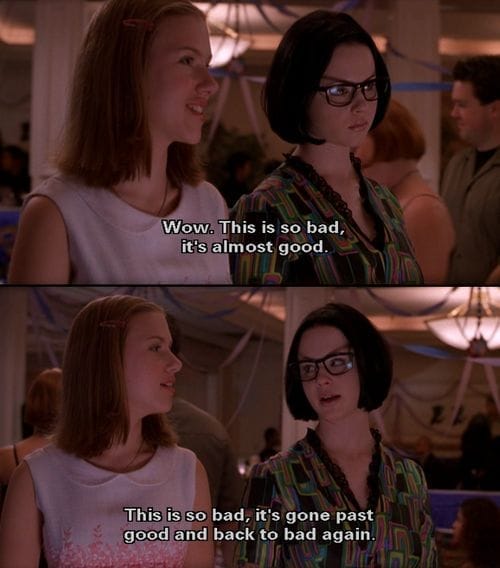
I learned how to hate properly in college. I was a Theater major. I learned a certain amount that has not come in handy. But understanding how to engage critically was a game-changer. When I saw a great play, my job was to think deeply about why it was great, how they made it great, then go write a bunch of essays about it. I also learned that you can glean a lot from a great play (or TV show, or movie), but you’ll get a fuckton from a bad one. Our professors were clear on this: not only were we not to leave during the intermission of a terrible show—we were to sit up and pay closer attention. (Then write a bunch of essays about it.)
Is It Bad? How to Interrogate Your Hate
Here’s a phrase those professors drilled into me: It didn’t resonate with me. If we made the mistake of just saying “I liked it” or “I didn’t like it,” it would trigger PhD level Contempt Face. Long pause, put-upon sigh or suppressed eyeroll, and then they’d prompt us back toward the light: “Mmm. I see. But: Why?”
Their perspective was this: sometimes, you don’t enjoy a thing. But that’s no reason to jump to conclusions about its quality. Maybe it was written for a different audience. Maybe it was not to your idiosyncratic taste. Maybe it just . . . missed you. (In retrospect, this was a hilarious thing to teach a lecture hall full of theater kids—how to stop assuming everything is about you.)
Investigating this was a fun project because it involved seeking out contrary opinions. Wading into that work’s genre, lineage. Sometimes I’d pop out the other end, like, yeah, no, shite. Sometimes—never mind, I was dead wrong.
Every piece of art was made by people, and people are delightfully, terrifyingly varied. In a mass-produced world, long live the individual, even when they make shit I think is baffling, you know? You shouldn’t love all great art. You can’t.
Add to that, there is no consensus about what a play (film, show) is meant to do. If you study the history of theater, you find a cornucopia of contradictory philosophies about why plays should even be written. So you realize that thoroughly judging a piece can—if you’re interested in stepping outside the teensy frame of your world view—benefit from context about why they wrote it in the first place. I’m not suggesting an artwork’s backstory should stand in for the work the actual piece has to do, but I am saying that if you go watch a pole dancer perform, you might find the ballet subpar.
In a mass-produced world, long live the individual, even when they make shit I think is baffling, you know?
To this day, I rarely leave in the middle of a “bad” movie or play, because I have this whole secondary entertainment machine happening: the circus of my brain engaging with why it’s not working for me. It’s made me a better writer.
The Other Side of the Coin: Your Reactions Aren’t Fixed Facts
I was recently in hell, by which I mean 82 pages into a 60-page pilot with 17 scenes left to write. I often end up rewatching something while I’m in that part of the process. Partly for comfort, partly to analyze why this other thing is great, so I can—hopes and prayers—apply it to my in-progress steaming pile of ass hair.
That’s how I ended up rewatching The Good Place. It remains an absolute banger. I’d totally forgotten that parts of the series finale are unexpectedly melancholy. I recalled that back when it aired, I was taken aback by that. Not what I would have done, I thought.
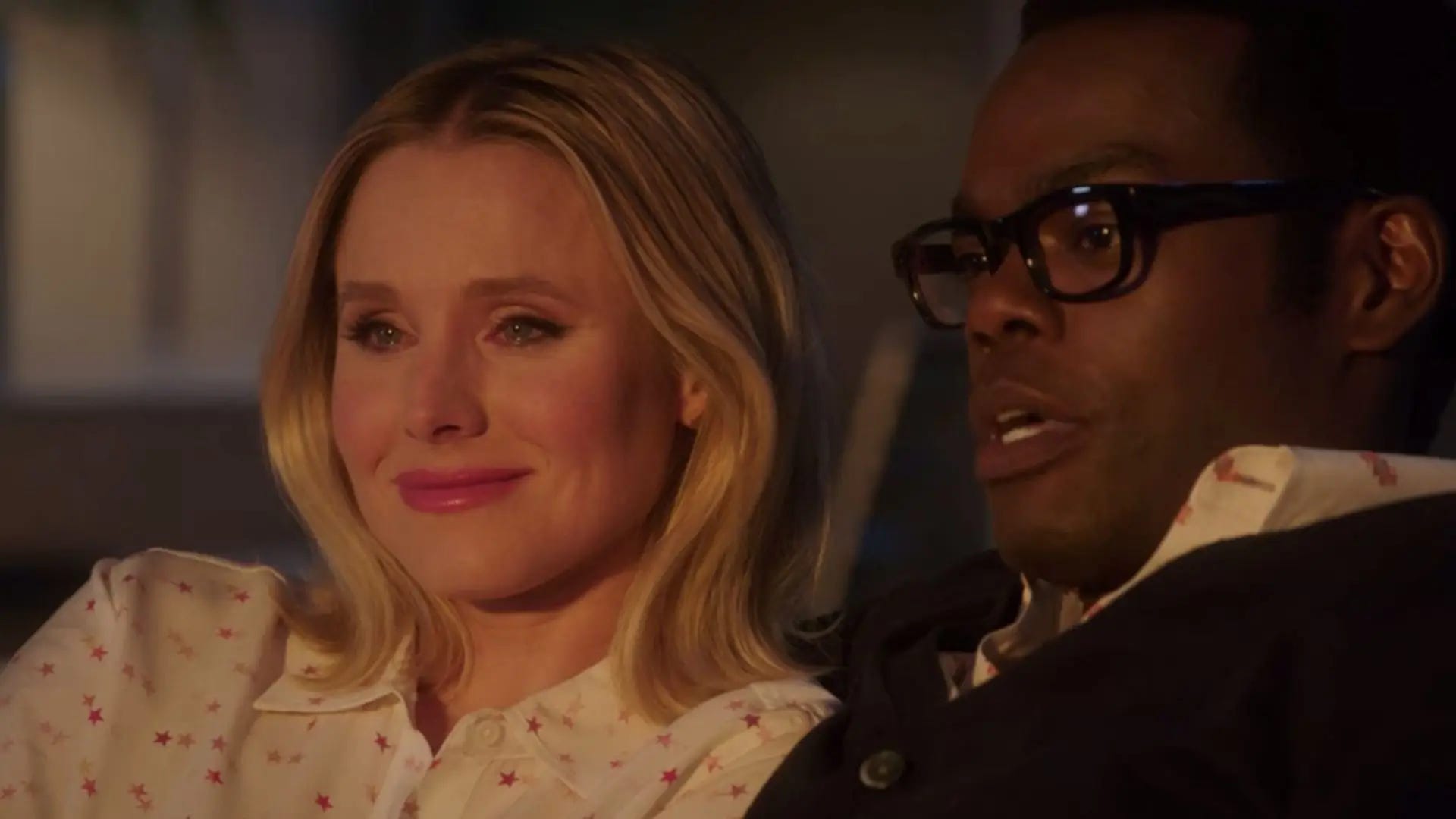
This time, from my mid-pilot-writing position (fetal), the finale resonated with me a lot more. I still cried, but this time, I also thought it was just right. Incredible. Perfect.
Well, you’ve gone through a pandemic. You got married. You’re older. Of course your relationship with death has changed.
Or maybe I understood the intent better because I watched it all in a lump. Or, I’d seen a bunch of other TV, and it changed the lens through which I saw this TV. Or trying to write that particular pilot changed me and what I like.
It’s notable when we like something more or less than we did. It proves that how we feel about a thing isn’t a fact fixed in eternity. It’s informed by all kinds of interior and exterior variables, and it evolves. That in itself is fascinating and worth tracking if you want to get to know yourself better. And it helps contextualize other people’s criticism of your work.
So, anyway, here are some questions I ask when I’m loving or hating something. The tl;dr is just an encouragement not to stop at your first judgment, but to investigate it. And one good way to practice this is to revisit something from long ago that you loved or wanted to kill with fire, so you can track your own resonances.
Questions for your inner hater:
Interrogate her!
When I’m taking in someone’s work, I zero in on what exactly I’m feeling, and/or what it’s got me thinking about. What do I think the writer is trying to say? But then: what’s the writer actually saying, whether they intended to or not? (The gap between these is where you really learn some shit.)
My goal with all that is to figure out how they pulled off (or not) what they pulled off (or not).
From there, I get mercenary—I ask questions engineered to help me make more work. Like: What do I care about the way this artist cares about their subject? What can I take from all this to make my stuff better? What tricks did they use that I can full-on steal learn from?
Try it. See what happens.
love,
SG
P.S. Oh, also: I'm starting a reader questions column. Send me your burning questions at AskSeraAnything@gmail.com. Thanks, freakies!
I'm of the opinion that all art is subjective too. Like some people find marshmallows objectively delicious and I hate them. So I assume that while I may dislike everything about whatever thing I am watching - for someone it's perfect. The why is more important! I wish I was objective enough to apply this to editing my own writing.