

Eleven Working Principles for Artists
some things I've learned over my years in the trenches with a notebook in my lap

Happy New Year, friends. To launch 2026 in a gifty spirit, I’ve made this week free for everyone to read. If you’re interested in more about writing craft, the TV business, and being an artist in the world, consider subscribing. Lots of good stuff planned.
Now then! In honor of beginning as we mean to go on and of continuing as we meant to begin, here are a few principles I lean on, gathered over decades of trial and error.
Hope these help in your lifelong project of going deeper into the work of your art.
1. Don’t make your idea dance like a monkey too soon.
Let it play before you make it work. That means: you see the holes and problems, and you let them exist while you give yourself the nosiest possible house tour of its every nook and passageway. Projects go better if you start in a state of being charmed by your ungainly notions, and follow where they lead in good faith.
2. A good night’s sleep is a power wash for your cluttered brain.
Listen, nothing annoys me more than discovering healthy shit works. I’m horrified when I note my mood improving after cardio. It’s absolutely infuriating when old injuries subside with proper nutrition and bodywork. How dare my relationships deepen when I apply myself in therapy? It’s so . . . unchic. I’d much rather live like the unreliable lovechild of a midcentury confessional poet and a 90s riot grrrl. But alas, I have deadlines.
So, sleep. There are studies on this. Your brain defrags while you dream. I’ve witnessed it a thousand times: by the end of the day, our writers’ room is stuck on a problem. We’re exhausted and frustrated and worried about leaving the office with it still up on the board, gloating at us.
The next morning, we return to the scene of our misery. But now, everything seems clear. Easy, even? We solve the issue in fifteen minutes.
Under pressure, it’s very hard to resist the impulse to grind. It feels dangerously counterintuitive to say, “You know what, let’s close at 4:00 today. Everyone have a nice evening. Get some real rest. See you caffeined up and good to go at 10 sharp.”
But it works.
3. Everything is a clue, so go weird places to investigate.
A couple of years ago, a dear friend had a stroke. He made a full recovery, but when he first woke up, he couldn’t say what he meant; spoken language had detached from its meaning and drifted out to sea. About a month in, we chatted on the phone. He was trying to tell me about a party. He called it a festival. He mentioned a person named Tessa; he used the name Sasha. He called an Apple Watch a thermometer. It was fascinating to track the logic—to see how the words he was saying lived right across the street from the words he was trying to find, so they’d jumped out when the ones he wanted wouldn’t answer the door.
The human brain is a glorious library built in a spiderweb. It employs mysterious filing systems. I couldn’t draw a map of my library; many of its rooms are frustratingly inaccessible. But I have to say, I enjoy the strategy I’ve developed: activating the librarians. I go places when I’m working, especially in early stages or when I’m stuck. Bookstores and cafes and theaters, parties and soccer fields and beaches, forests and furniture stores. I invite these places to ping the spider web. And they do. A William Eggleston exhibit will trigger a cascade of memories about a childhood road trip. Watching fireworks will remind me of Brokeback Mountain which will segue to a friend who wears cowboy boots and makes a fabulous brisket which will cue Thanksgiving 2022, and I’ll abruptly realize my script needs a character who is both a local real estate agent and an Etsy witch. No, I can’t retrace the rest of the librarian’s steps, but I can report that the script is going much better now.

4. Refuse to be shamed for your whimsy.
Some people will be triggered by your delight and by your tenderness toward your own eccentricity and wounds and darkness. That’s about their injuries, the things inside them that have not been given a voice. Don’t allow their theory that your strangeness is wrong to infect your work. Don’t presume they know more than you do when they assert that your subject matter is inappropriate given the horrors of life. Don’t submit to a demand that your art address their view of the world. Don’t invite them to dictate how you express your view of the world. You are doing the broken, healing parts of yourself a profound service by protecting them from censure. Any time someone advises you to be silent, take a step back and examine their motivations as impersonally as you possibly can.
5. Know when you’re working for God and when you’re working for Caesar.
The first time I heard the idea of artists making “one for God and one for Caesar” was in an interview with Guillermo del Toro, a filmmaker famous for both soulfulness and pragmatism. He was talking about the type of work you burn to create versus the type you’re hired to do. The latter usually pays a lot better.
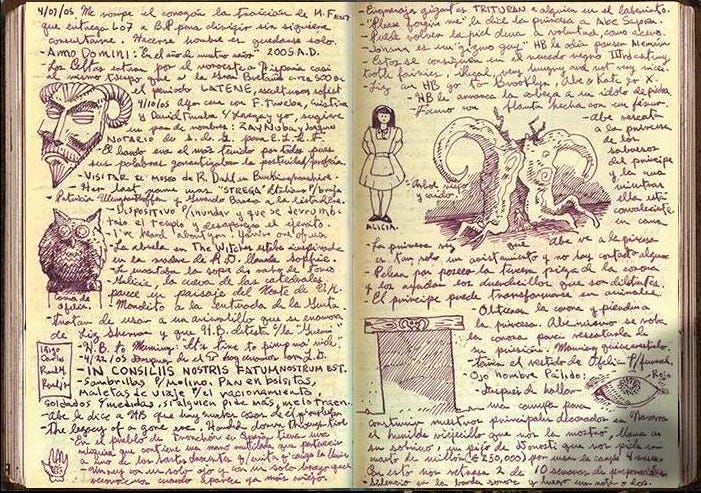
I love doing it for God (/the muse/myself)—following some notion like a six-eyed purple rabbit down its interdimensional hole just to see what’s on the other end. I also enjoy making art the way I do it for a living—the platonic ideal of that, anyway, which involves crafting ideas with smart collaborators and the resources of a studio.
But Caesar work isn’t the same as God work. They require different sensitivities, different comfort levels with experimentation and introspection. Not to meantion deadlines, notes, and working in public. I would go insane trying to write a TV show the same way I write poetry and fiction. More to the point, I’d be fired.
At the same time, I’m not capable of half-assing an assignment, whether I got it in poetry class or via contract with a streamer. There’s no version of “writing for money” that results in my phoning it in, whether or not the buyer can tell the difference. There’s no “writing for myself” that means treating it as a lark that wouldn’t eventually lead to evaluating every comma through an electron microscope.
For my sanity, though, I make sure I’m not looking to a professional assignment to feel the way God writing makes me feel, or vice versa. I’m not asking a script to feel like a languid swim in the collective unconscious. I’m not expecting development execs to talk with the same reverence for art that my writing teachers do. I’m also not judging a short story by its inability to attract a Netflix-sized fan base. I’m not heartbroken when God isn’t seduced via plot twist, and I’m not depressed that I’ve never been able to appeal to Caeser via sestina.
Before we move on, I do want to reiterate: it is really okay to make work for Caesar. I mention it because our culture has a purity kink when it comes to artists. It likes to shame artists for using their quasi-mystical abilities in the service of paying the dentist. Fuck ‘em, friend. Compromise, a core tenet of serving Caesar, is the process by which most artists get their stuff in front of significant audiences. It is the process by which artists pay for their kids’ ballet shoes and their parents’ home health care. I suggest you triple-check that you’re not slinging purity biases at yourself, then pointedly ignore anyone else who hurls them your way.
And when you are making something for God, something meant to feed your pious, perverse little inner artist? Do that with your whole chest, and forget Caesar as thoroughly as you forget the IRS once your taxes are filed.
6. Secretly, Caesar desperately needs you to embed a little God.
Fine, I’ll say it: whatever the courts believe, corporations aren’t people. They more closely resemble machines: of profit, innovation (which leads to profit), and societal impact (which leads to profit). They don’t care how your work connects to your spirit; they care whether your product does what they need it to do.
Now, as for every person working within said system: they are all people. Human beings have needs beyond the requirements of the machinery in which they toil. I’m talking about the folks all along the career ladders of those companies. And the ones who answer their phones, mop their conference room floors. The ones who pop the popcorn and write the reviews that appear on sites that are also machines. And the audiences who subscribe and buy tickets and wear the merch. All of those people benefit in ways beyond simple quantification from the God (muse, imagination, heart, dream residue, passion, bliss, rigor) you embed into the product.
And here’s a thrilling secret I discover every time I care to investigate: the work you make for money has so many hidden pockets to tuck joy and messages and truth. Doing this will make you feel better about the constraints of the work, and it will improve the work itself. It will give you maximum agency in a situation where you are, to an oft-uncomfy extent, being told what to do.
Even the most data-driven money people, even the glassiest-eyed audiences, benefit from being fed real nutrition inside the hyperprocessed snack they ordered. They won’t even taste it, because you are a skilled chef. But it will nourish them. And you will know it is there, and that will nourish you.
7. Be alert that Caesar will sneak into God’s work.
I wish it was easy to snap the dial to OFF, but once we’ve engaged with Caesar, we often discover that we have internalized that stream of criticism, notes, requests, conditions. It’s hard not to hear echoes even when we’re making something on our own time with no plan to invite the machine to monetize it. It’s important to listen for that Caesar whisper, so you can get up from the desk, take a walk, have a nice spoonful of peanut butter and a few cleansing breaths, and then tell it to fuck the fuck right off so you can make the work you want to make today.
8. Love exactly what you love.
I like my fiction speculative. My heart flutters for a monster. I’m wildly happy to spend all day on fantasy and sci-fi and horror and fairy tales—genres traditionally viewed as less culturally important and more “popcorn.” In my lifetime, I’ve encountered many people who don’t resonate with or respect what I like. They’ve told me I have bad taste, or that I am wasting my ability in the telling of fundamentally inferior stories. When I was younger, I would sometimes believe them. This would lead to second-guessing myself, which would deplete my ability to do my best work. Now, I don’t give their opinions a molecule of inner airtime. I like what I like. I make stuff for the people who want it. There are plenty of those people. For you, too.
9. You’ll need to write it before you understand it.
The game you’re playing with a project may involve some kept gates. You may need to give explanations as you go. To your colleagues, patrons, development exec or thesis advisor. That’s what pitches, outlines, check-ins and sharing work-in-progress pages are. But assure yourself that you are providing those things as a placeholder so you can get the sign-off to continue. Allow yourself to insert a little bullshit when necessary to connect as-yet-elusive dots for those people, so that you can get the fuck back to work. Promise yourself that you are allowed to change your mind when you discover more about what you are making. Don’t let the business of the gatekeepers detract from your private enjoyment of discovery.
10. Invite your own company by writing down your thoughts.
Your journal exists for you to talk to yourself so you can see what you’re actually thinking. Once you have a sense of what you’re thinking, you can investigate whether you have grounds to be thinking that. This is the whole sport of ideas: dreaming them up, testing them, applying them. Journaling on the regular is a way to get into a gym routine to stay in shape for your big events. It is easier to be in conversation with your work when you are already in conversation with yourself.
11. Your art is precious in ways that are none of your business.
History tells us Mark Rothko was a flawed and troubled human being. We can’t know what he was thinking when he painted the orange work that hangs on the 4th floor of MOMA in New York. Reasonable, though, to assume he wasn’t envisioning it on that precise wall, gazed upon by 2.5 million people each year. Much less that in the century following his death, it would repeatedly be visited by a frizzy-haired, 5-foot-7 Los Angeles-based writer who bought her platform boots with money made running TV shows. That she would, each time, make it sound like she was planning a “normal” trip, but was in fact flying across the country specifically to look at this piece of art. That she would come to understand, somewhere around the third time she arrived as the doors opened and raced upstairs to be the first person on the 4th floor, that she was making pilgrimages in much the way seekers trek to holy sites. This, of all pieces Mark Rothko ever painted. This, of all works ever painted by anyone.
It is also vanishingly unlikely that Rothko had any inkling of the things she would then write in her journal while eating butternut squash soup at the museum cafe. Much less that some of those things would make their way into love letters to the man she would one day marry, or that other things would become a poetry collection to be published in, of all bizarre-sounding years, 2026. What his art would do for her was none of his business. It had no impact on his life and he never knew a thing about it.
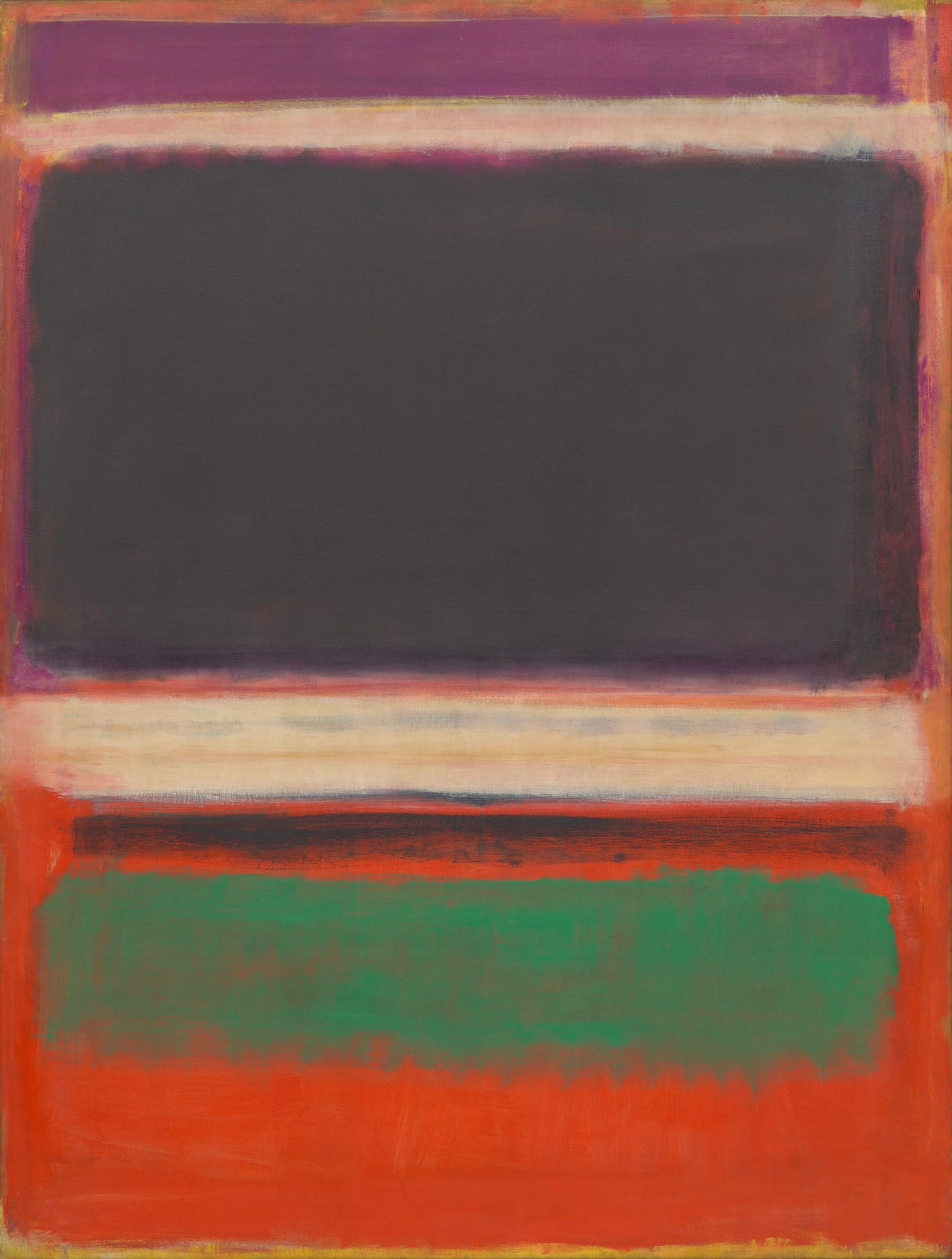
Lest you be distracted by the fact that Rothko is one of the more famous painters ever, I’d add that I could have written this paragraph about: the Damien Echols episode of The Midnight Gospel, the “Nosedive” episode of Black Mirror, a linocut of a man sewing shut an animatronic dinosaur gifted to me by the artist Katura Reynolds, “Aubade” by Tracy K. Smith, Alexander McQueen’s wedding gown with horns tearing through the veil, the broken-china fountain in the garden of Disney Concert Hall, the Pale Man in Pan’s Labyrinth, “Bullet in the Brain” by Tobias Wolff, Chopin’s Nocturne No. 20 in C# minor, and Proof by David Auburn. My work will not have the same afterlife as Rothko’s—whatever does happen to it is none of my business, of course—but since it has required me to speak on several ComicCon panels, I happen to have met people who watched my episodes while in chemo, or in grief, or in love, or on particularly illuminating shrooms. So I do get to know a tiny bit about what my work meant to them, and can extrapolate that another person or two is out there somewhere, their feet up in casts or their belongings in boxes or their heart on the mend. Or not. Or there will be in twenty years. Or not. My job is to make the thing with clear intent, then let it go. As I’ve matured into my practice, I’ve grown to fucking love minding my business.
Happy New Year! This post has filled my heart with warm joy and wisdom. Please keep minding your business.
Meanwhile, can I make this into a poster and print it?
Happy New Year! You've inspired me to take up journaling again. Time to revisit THE ARTIST'S WAY.